
Monday – June 5 in Oslo Norway:
Maggie’s Photos
Photos from Clay:
Monday – June 5 in Oslo Norway:
Maggie’s Photos
Photos from Clay:
Today was rainy and cool, so we went to the art gallery of the National Museum, which displays art from Roman times up to the mid-twentieth century. Much of it is from Norwegian artists, but there is art from all over the world. (There’s even one piece by a Swedish artist, Anders Zorn.)
The go-to piece here is Edward Munch’s “The Scream.” As you might expect, it draws quite a crowd – but unlike the Mona Lisa, you still can get close enough to appreciate it – if art appreciation is what you had in mind.

Maggie and I hadn’t had that much exposure to Norwegian artists. We were impressed by the quality, and by how connected they were to trends in the rest of the art world. They had an intense appreciation for the natural world around them; even though it was sometimes pretty harsh, they found beauty.
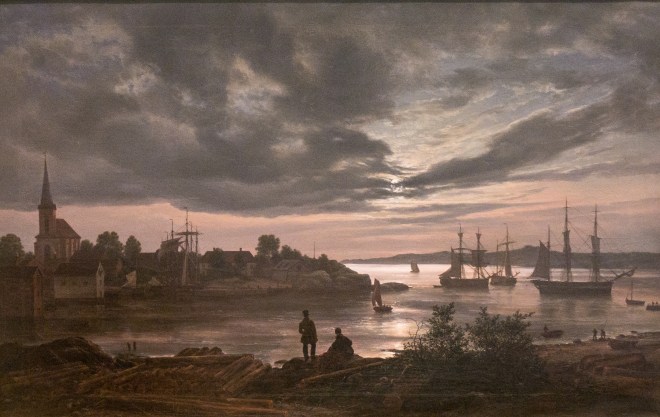


Another feature that differentiates the Norwegian art is how unhappy so many of the subjects were. For the most part, they were sick, hungry, cold and tired. The people seem to feel all of the depths of the human experience with very few of the heights. Their only saving grace seems to be that they had artists of passion, skill and empathy to capture their misery.
The art from the rest of the world is more upbeat. One piece that stood out to me was Artemisia Gentileschi‘s “Santa Maria Maddalena Penitente.” Take a look at this for a minute:
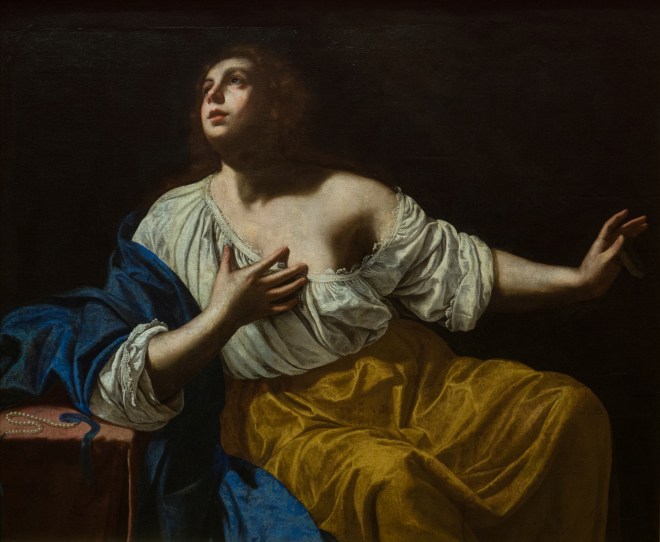
This painting is unusual for several reasons: for one, it’s by a female artist, one of the few women painting in the post-Renaissance era; for another, the tone of the painting is completely the opposite from that shown in most of the other paintings of Mary Magdelene, where instead of being filled with inspiration as she is here, Mary is either sexualized, consumed by regret for past sins, or both; her life is spent, and all that remains is fear of divine retribution. It goes without saying that those other works were all painted by men.
For us, the one take-your-breath-away painting was Andrew Wyeth’s “Albert’s Boy.”

It’s hard to see in this picture, but the level of detail is amazing. Maggie and I were sucked into this boy’s world and couldn’t get away. Even the detailed photo below doesn’t begin to show the work that went into making this painting. The surface has been repeatedly scraped and scratched, then washed over with a fine glaze. Clearly, Wyeth was expressing the depths of feeling that were raging under this placid exterior.
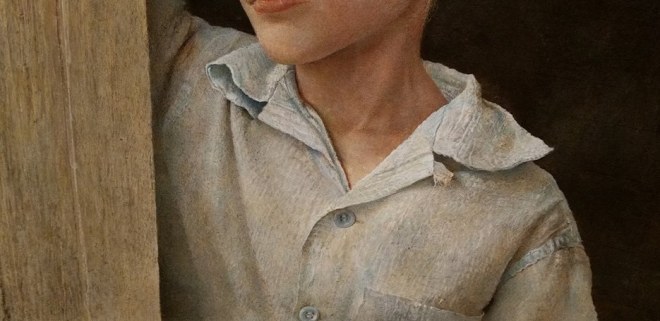
It was a good reminder for us of why we need to keep going out to look at actual paintings. A photo just can’t convey the three dimensional reality of an original piece.
All in all, this is a fine art museum. There’s a nice variety of art, it’s all approachable, the crowds were manageable on the day we went, and it’s a decent size, so we weren’t overwhelmed at the end of the visit. If nothing else, for a few hours we left the crushing reality of the outside world and entered into other people’s reality for a little while. I’m happy to say that we were glad to be back – those “good old days” weren’t necessarily as good as people would like to think.
On the first Saturday in June, Oslo welcomes summer with hundreds of musicians on almost 40 outdoor stages, pulsating the atmosphere all over town. All sorts of genres are represented: rock, country, pop, electronica, jazz, hip hop, world music, choirs (even Norwegian folk music, they say — but we haven’t heard any of that). The Norwegians declare it National Music Day; the local version is Musikkfest Oslo. Bands play in streets, parks, stages and squares, from noon to midnight, all over town.


It’s all for free – we don’t know who pays the musicians, but we assume it’s a government function of some sort. If this is Socialism, I say: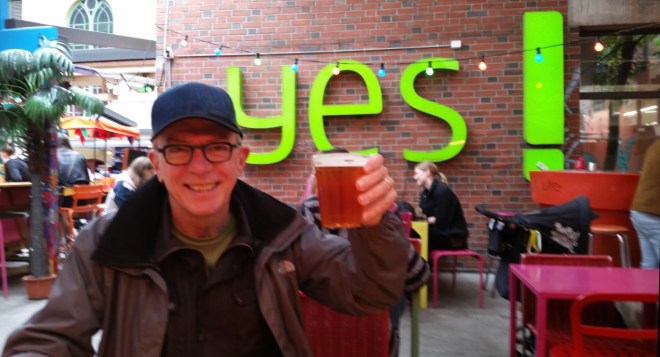
There’s an open air bar in the block behind us, so we don’t have to leave the apartment to hear music. Unfortunately this venue leans more towards Euro/techno pop that’s not our favorite. After today, we may develop a taste for it. (We have definitely developed a taste for the pizza and beer they have there. Spicy sausage and an IPA – yum!) And hey, if you don’t like the music, you can always start your own band.

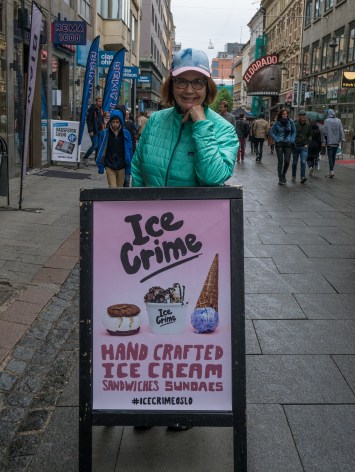
Yes, Austinites, this is June 3rd, and we’re wearing jackets. Some of the locals are in short sleeved shirts, a few are in shorts — but hey, it’s less than 100º, so we’re bundling up. On the other hand, it takes a lot to discourage us from getting an ice cream cone.
General:
First impressions of Oslo have been great. Perhaps it has something to do with delirium from jag lag or the wine? Regardless, adjusting to Oslo has been quick. The first night here I slept 13 hrs. straight through and 11.5 hours for Clay! Wow! Never done that on an overseas trip before. Our AirBnb apartment is just what we had hoped for when we booked it months ago. It is in a great location and has a separate bedroom, kitchen, bathroom (with washing machine), living room/dining room, and a nice entry way. AirBnb rocks!
Prices:
I am so glad people had warned us about prices in Norway. They were correct! We were prepared for it by planning to spend less by only eating out once a day. Lunch is the cheapest meal (daily specials) so we have made that our main meal of the day. Curious to me is why the grocery store prices in our neighborhood “cheap” grocery stores is about what you find at Whole Foods. We were actually happy about this when you compare it to eating out.


Wine prices didn’t surprise us too much because we were in Sweden last year, and know about state monopoly prices. You can only buy wine at the state stores; however, we found wines we were familiar with, and the prices looked like Whole Food’s wine department prices. Where is Trader Joe’s when you need them?
Beer is the strangest of all. You can buy beer at only 2 types of stores. Beer can be bought at local grocery stores, but only beer with less than 4.5% alcohol. An IPA will run you about $4.00 per beer so consider our surprise to pay $24.00 for a 6 pack of beer. Think we will be drinking wine here.
The state monopoly stores sells beer with alcohol greater than 4.5%. Apparently drinking is a problem here with such long cold winters, so the government is trying to control drinking by only allowing purchase at state stores. Maybe they should switch over to coffee, like the people of Seattle.
People
Oslo folks are friendly and English widely spoken. Good thing because our Norwegian is almost zero. There is a surprising diversity of people here, and I would assume because of the new immigrants. Lots of ethnic restaurants in our neighborhood and we approve!
One of the things we have observed is – like Stockholm, you see Oslo men everywhere pushing baby carriages. I absolutely love this! Both parents receive time off from work. Parental leave – how civilized.

Maggie and I are off on our next big trip: we had so much fun in Sweden last August, we decided to beat the Texas heat and spend this summer in Scandinavia. We’re actually not going back to Sweden on this trip, but not for any reason other than it’s a big world and we’ve seen so little of it, we don’t want to repeat ourselves. This year’s itinerary is a tour around the Baltic Sea: Norway, Finland, Estonia, Latvia, Lithuania, finishing up in Denmark, then back to Austin.
We didn’t plan this trip as thoroughly as we usually do. By the time we wound up putting on two weeks here, an extra few days there, we had a total of 99 days that we’d be gone – completely forgetting about the 90 day limit for foreigners to stay in the Schengen region. Surely that wouldn’t apply to us! Who would not want a few more days of Clay and Maggie! But no! A little checking revealed that it depends on what country you’re leaving from – the farther south you go, the less they care. A stern warning from the Dutch customs agent on our arrival, confirmed by a quick email to the Danish embassy in New York, was enough to chastise us. Feeling like stupid Americans, we are having to change our return date to the 28th of August, our 90th day.
One way that we did repeat ourselves was to have our luggage lost in Amsterdam. For the third time in a row of changing planes in Amsterdam, our luggage remained at the airport while we flew on to our destination. In this modern age, everything is recorded and tracked on computers, so the woman at the lost luggage counter in Oslo could tell us exactly where our bags were; she just couldn’t tell us exactly when we would get them — that requires human intervention. At this point we’re still waiting for the baggage delivery human to intervene. We’ve been wearing these clothes since Tuesday and now it’s Thursday afternoon, so we are anxiously anticipating his arrival.
Well, it’s a beautiful day – warm and not a cloud in the sky, so we’re going to head out a little and explore our neighborhood, while keeping a close ear to the phone for the luggage delivery guy. More stories and pictures to come!


As you can see, the luggage delivery guy eventually did show up.
It’s hard to believe that we arrived in Budapest last April and now in a heart beat, we are reaching the end of our European adventure. It has certainly gone by too fast for us. We have learned so much about the culture, history, and day-to-day lives of the people in places we have stayed – Hungary, Scotland, England, Ireland, Germany, and Sweden. Along the way we also learned more about ourselves, our marriage, and what retirement means to us. Throw in a few pleasant, but unexpected events, and I would conclude that this has been a perfect trip.
We hardly knew what to expect when we sold the Austin condo last year and began planning this adventure. There have been some pleasant surprises on this adventure and one or two that we would like to forget – like my cell phone dying! I have asked Clay to add to my list of surprises on this trip; here is a short list of our biggest surprises.
As we prepare to head back to the U.S., we are looking forward to spending some time with family before settling back in Austin for a few months. We have rented a place in downtown Austin beginning September 25th for a few months. This will give us time to plan our next adventure. We don’t know for sure where that journey will take us, but if anything it’s like this one, it will not be boring.
Maggie and I worked in a couple of days in Gothenburg to see our friend and former co-worker, Aleks Niemand. We had a great time; it’s always enlightening to see a city through the eyes of a local: you not only get the food, history and culture, but you get a view into peoples’ daily lives, which you don’t get from Tripadvisor or the Hop On / Hop Off Bus. I think and Aleks and Maggie are enjoying themselves!

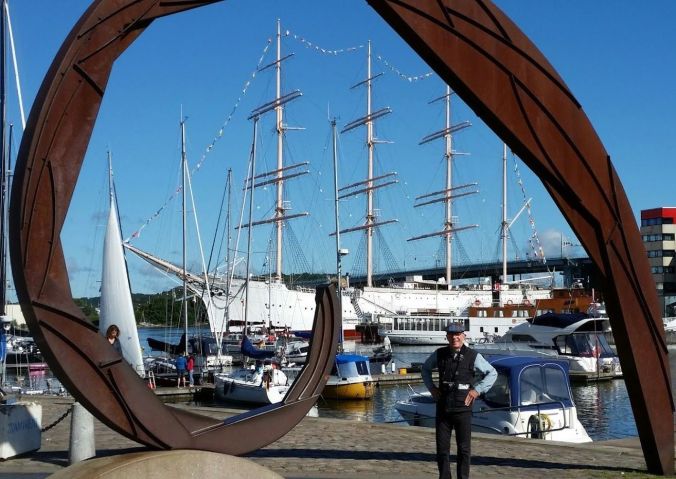
Gothenburg is on the west coast of Sweden, a three-hour trip on the express train. With a population of over 500 thousand, it’s about half the size of Stockholm. They city is laid out along the seacoast, with the Gothia River running through the middle of it. It’s smaller and more relaxed than Stockholm, but there’s still plenty to do. There was an international cultural festival going on while we were there, so the streets were filled with people, music, art and food from all over the world.


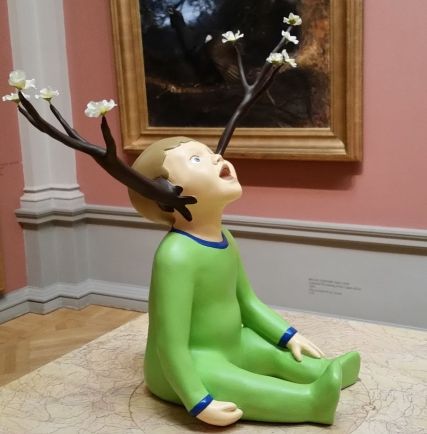
The art museum has one of the more eclectic collections we’ve seen. It’s laid out by country of origin rather than being organized by year or by style, so French art is in this room, Dutch art there, and so on. It leads to some interesting mixtures, with modern sculptures placed with Art Nouveau paintings, but it seems to work.


We only spent a couple of days in Gothenburg, which was not nearly enough to do everything we wanted: we saw the food market, but not the fish market; we only saw the south bank of the river, but were told that the north shore is also well worth the visit. Volvo was founded in Gothenburg, and we heard that the Volvo Museum was worth a visit. Certainly with so much to see and explore in Gothenburg, we definitely will be back. An added bonus is that our friend Aleks lives there and we get to see him again.
Here’s a quick summary of our favorite places, sites and features of Stockholm:
Archipelago – We only visited two of the many islands: Fjäderholmarna and Vaxholm; both offered a different view of the history and people of Sweden. Vaxholm has an ancient fort that is now a museum. We ate a traditional herring dish at Hamnkrogen, which is a good place to hang out and see what the locals are doing. On Fjäderholmarna, we saw what Stockholmers do on their days off: find as much sunshine as possible. We discovered that even in those rustic surroundings, there is art everywhere; we also found that the Swedes are as crazy about their flag as Americans are.


City Hall – not a museum specifically, but there are sculptures, murals, architecture, and it’s the site of the annual banquet for the Nobel Prizes, so the tour is interesting.


Drottningholms Slott – the Queen’s Palace. We had just missed the start of the English language tour when we arrived, so we went off on our own (there is no audio guide) and regretted it. There are very few signs in English, so for much of the time we stared at stuff that might have been significant, but we didn’t know why. The gardens are supposed to be worth a good look, but it was windy and rainy that day, so we didn’t see much of them. We would have gotten more out of the trip if we’d planned a little better, but sometimes you just have to go when you can and make the best of it.


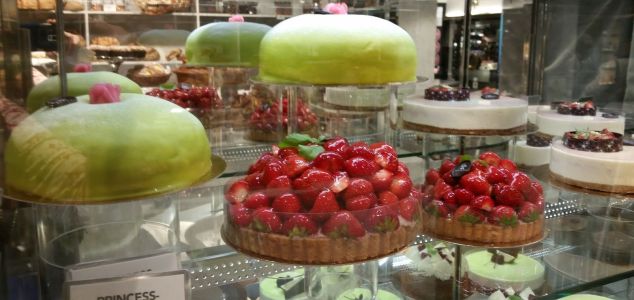
Fika – the mid-afternoon coffee break that includes all sorts of desserts: cheesecake in all of its forms, carrot cake, strawberry rhubarb pie, endless variations of chocolate – and some we hadn’t seen before, like Princess Cake.
Fotografiska – the Photography Museum. As far as we know, there are no permanent exhibits at the museum; when we were there, the highlights were Nick Adams and Brian Adams. We also liked the Greta Garbo pictures, taken or collected by a life long friend. The cafe at Fotografiska has been called the best museum cafe in the world. That may be true, not only for the food and atmosphere, but the spectacular view of Stockholm. This is also the only museum we’ve been to that’s open until 1:00 AM on Thursday nights.
Historiska Museet – the Swedish History Museum. A thorough introduction to the history of Sweden, from prehistoric times to the present. There’s an extensive exhibit on the Vikings:, with plenty of material on sailing and battles, but also a fair amount of cultural information, too. For instance, I never realized that the Vikings had converted to Christianity, or had done such amazing jewelry.
Nobel Museet – the Nobel Museum. There’s a lot of information on the Nobel Prizes and the winners. In our view, there was too much effort spent on humanizing the laureates, but not enough telling what they did, why it was significant, or how why they stood out among their peers.
People – Swedish people aren’t generally effusive, but they do have a deep sense of kindness, which translates to tolerance and fairness when dealing with others. We experienced that ourselves as sometimes confused foreigners and random people would stop what they were doing to set us straight. Statistically, it shows up in the current refugee crisis: Sweden has taken in more refugees per capita than any other country: 400,000 with a population of 9.5 million. (Germany has taken in a million refugees for a population of 80 million; the U.S. contribution is paltry by comparison.)
Pride Week – the whole city of Stockholm turned out for Pride Week. There were rainbow flags everywhere: restaurants, stores, hotels, even city buses. The Pride Parade went on for hours, which it needed to, since tens of thousands participated and hundreds of thousands watched. There was a little bit of everything in the parade: Stockholm police and fire departments, the American Ambassador to Sweden, the Swedish Army (singing Y-M-C-A), gay Jews, gay Muslims, even a rainbow Viking boat. Locals told us that there really isn’t a “gay scene” in Stockholm because they are so integrated into day and night life, there isn’t any need for one.


Prins Eugens Waldemarsudde – the house, collection and art studio of Prince Eugens, a pretty good amateur painter who just happened to be a prince, so he got to paint what he wanted, including a mural in City Hall. The top floor was devoted to his studio, which of course had perfect lighting and tons of space. The temporary exhibit was about Swedish female plein air painters of the late 19th century: their art, their lives and their struggles.


Restaurants – we can’t try to do a thorough review of the best restaurants in Stockholm. For one thing, we tried to hold down costs by eating in the apartment for two meals a day (mostly breakfast and supper). We liked our local Thai place, Hang Chow for good food, fast service and low prices; Vau De Ville (near the Opera) has a nice selection of traditional Swedish and other food; Gnarly Grill for the wait staff, plus a decent variety of bar food and draft beers; Ciao Ciao for Italian food, low prices and the cabbage salad that Maggie loved; Pesso Bageri, our local bakery – and while we’re at it, Gelateria Italiana across the street. There are many, many others; we haven’t even scratched the surface.
Skansen – the world’s oldest open-air museum, devoted to the history, culture and animals of Scandinavia, with the emphasis on Sweden. We spent several hours there, and came away with a better appreciation of the country.


Transportation – we loved the public transportation; no need for a car, just buy a monthly pass and use the subway, buses and trams to get anywhere in the city. The whole network fits together well, so you can go from bus to subway to intercity train with a minimum of walking between stops and waiting for the next departure. Walking is also not a problem, since there are relatively few cars on the road for a city this size and drivers respect the pedetrian right of way. (Watch out for those bicycles, though – mopeds and scooters can ride in the bike lane, so you have to look carefully before crossing the bike path.)

Vasa Museet – museum of the Vasa, a sailing ship that sunk in 1628, mostly due to poor design: it was built too narrow and with two rows of guns, so the lower gun ports took on water in light seas. They knew that before it sailed, but it was needed for the war with Denmark, so it was pressed into service anyway. When the Vasa sailed out on its maiden voyage with all of its gun ports open, the crowds of people on the shore watched in horror as it sank within a few hundred yards off shore. The ship laid on the bottom for more than 300 years until it was recovered, remarkably intact because the Baltic Sea isn’t salty enough to be a good habitat for shipworm; otherwise it would have been devoured by then.


So there you have it – the highlights of the month we spent here. There’s a lot left to see and do, but we need to get back. For a lot of the places we’re seeing, Maggie and I think that this may be our last visit, but we hope that’s not the case for Sweden.

Maggie and I had been to the “old” Berlin – she in 1988, a year before the Wall came down, then both of us right after, in 1991. Maggie remembers East German soldiers everywhere: in the train stations, guarding monuments, patrolling the streets. In 1991, we saw bullet holes in walls, leftovers from WWII and the shadow of the East German logo on walls, which had been up for 50 years and only pulled down recently. We remember Berlin as an intense city; everything on edge, everyone at the limit of what they could tolerate and still function. Berliners did their best to cover up the stress with humor: painting the Wall, inventing sarcastic names for city landmarks, but still the tension showed through.
Berlin today has a totally different vibe; and with only one week we discovered a new Berlin much to our liking – upbeat, modern architecture, museums, art galleries, and the beautiful 18th Century Brandenburg Gate, an iconic symbol to all Berliners and visitors of the reunification of East and West Berlin. They haven’t covered up the past, they’ve included it in the cityscape. There is a monument to the victims of the Holocaust that covers a city block; an entire museum is devoted to the horrors of the Nazi and Communist secret police. There are monuments that show the former sites of churches and synagogues. The former site of Hitler’s bunker is marked with a plaque (there’s an apartment building there now). The path of the Berlin Wall is marked on the ground as it winds through town. The emphasis, though, is on living today. In the heart of town, on Potsdammer Platz, there was a week-long festival called Berlin Queer Days. Brandenburg Gate was the backdrop for an outdoor music festival. Many of the Brutalist concrete buildings that were thrown up after the war have been pulled down and replaced with modern architecture.

This stop was special for Maggie and me because we got a chance to spend time with family and friends: Maggie’s brother and sister-in-law Paul and Susan shared our apartment for a few days, which we had planned months in advance. A short time before we left, our friends Kirby and Maureen asked for advice on where to go in Europe; we told them we’d be in Berlin, why don’t they meet us there, and they took us up on it. Naturally, knowing Paul and Susan were going to be there and that we were all political junkies and yellow dog Democrats was a big incentive, too. We all had a great time, and got along just like Maggie and I thought we would. We’re all more or less the same age and the same political persuasion, so we had a good time talking politics and trashing the other side.
Traveling with other people is a treat, because you do things that you might not have otherwise. Because of Kirby and Maureen, we caught a free show of live music at the Brandenburg Gate. Paul and Susan wanted to go to Potsdam, which Maggie and I had never seen, so we got a look at the Bridge of Spies, where spies and other prisoners were exchanged between East and West during the Cold War. We also got to tour the complex that hosted the Potsdam Conference, where Britain, the U.S. and Russia decided the fate of post-War Europe.


Paul, Susan, Maggie and I shared a two-bedroom Air BnB apartment in the Sony Center.It’s a great location for convenience and access to metro lines, but a little noisy at times, with crowds of people in the huge central plaza and the streets around us. Typical for Germany, there was no air conditioning, so we had to leave the windows and front door open to get a breeze going in the afternoon. That probably isn’t an issue 51 weeks out of the year, but we happened to hit Berlin during a heat wave, so we had to put up with it. It got cool at night, so the heat wasn’t a big issue.
Paul and Susan are walkers and history buffs like us, so we had a good time exploring the city and learning more or German history. Once again, we saw how easy history is to learn for Americans, and how complicated it is for other countries. Now that we’ve spent a little time learning, we know a little more about The Reformation, the 30 Years War, and even their more recent history, which we were pretty familiar with.


Back on our own, Maggie and I went to the Olympic Stadium, scene of the 1936 Berlin Olympics. The place is definitely impressive for its massive scale and utilitarian design. Today there are just a few reminders of the past, like the plaque showing the 1936 gold medal winners. Today it’s the home of the Berlin soccer team, and the pool is used by everybody.


The impression we came away with is that Berlin is a more complicated place than Americans typically give it credit for. It was the center of a world that is thankfully past, and also taking its place as a leader of a world to come. I would argue that because of its troubled history, Berlin is uniquely positioned to help the rest of the world fall into the extremism that might otherwise take hold. We would be wise to pay attention to Berliners’ take on current events.
 Clay and Maggie Travel