Dresden – Past and Present Glory

Everything you’ve heard about Dresden is true, and laid out for all to see, It’s a beautiful city; perhaps once more beautiful, but the ravages of time have taken their toll – especially the bombing by the British and Americans in 1945. Like a faded dowager, she covers her blemishes and goes out for a good time in the Alte Stadt (Old Town), never forgetting the past, but not allowing it to define her.

It’s not all about the past, though. Dresden is a young city too, with thousands of university students, several high tech companies, and all sorts of entertainment options, from fine dining to just sitting and watching people go by.  A great place to visit and see a lot of interesting people and street art is in the Neustadt District.  Maggie and I spent an entire day hanging out in what we called an “East Austin Look Alike” district.  We both loved the street art.

Transportation is easy; there are trams and buses everywhere, and the system is pretty easy to figure out. We had two trams that stopped a block from our apartment, and two buses that stopped two blocks away. Together they took us to Neue Stadt, Alte Stadt and to other places of interest, such as the Military History Museum.

We were surprised what a big deal Dresden had been in previous times. The  Gemäldegalerie Alte Meister (Old Masters Gallery) has several first rate pieces and artists, including Raphael’s most famous painting, the  Sistine Madonna.

We’ve said this before, but we saw another example of how the Germans are dealing with their history. You’d be hard pressed to find a people that look at their past in this much detail. In Dresden, there is the Military History Museum, which discusses the causes and consequences of aggression throughout history. There are exhibits that go back to the middle ages, but a large part of the permanent exhibit space is devoted to the horrors of WWI and WWII. Because this is a military history museum, there is less attention given to the Holocaust, and more to military atrocities: the invasion of Poland, the bombing of Rotterdam, decimation of Eastern Europe – and of course, the fire bombing of German cities, with Dresden being the primary example. There’s a collection of artifacts: bombs, bullets, the wing of a P51 fighter, pinned up like it was torn from some giant insect. The emphasis of the museum is on the human experience of war: a sound wall of a battle, where shouts and screams seem to come from everywhere; helmets pierced by bullet holes; a door that opens to the smell of a trench. We came away crushed by the experience. You can’t go through this museum and come out feeling that war is just a tool that politicians can wield to suit their purposes.

Maggie and I had a unique opportunity to see life out of the tourist districts. We contacted a former coworker of mine, from AMD days many years ago. She hadn’t changed a bit, except she now had a husband and three children. You never saw such a happy family. The kids played outside, interacted with the adults, and generally acted like you wish your kids would act when they’re around other adults. They have a beautiful life on the outskirts of Dresden. We took the tram to the last stop, then walked a half mile through the woods to get to their house.  We were treated to an old fashioned barbecue with lots of German sausages and veggies, and a little schnapps afterwards.  I even had the chance to teach their son a little about building a fire. I hope I didn’t set his development back too far.
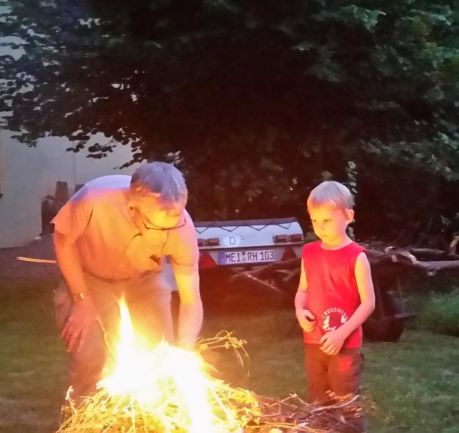
clay fire


Being in Germany, how could we pass on visiting the local Volkswagen factory?  They have a state-of-the-art auto plant, which VW calls the Transparent Factory, built in 2002 to build the Phaeton. You know it’s something new just walking up to the place. Inside, the major walls are all glass: floor to ceiling glass on the outer windows, there’s a glass wall separating the offices from the factory, even a glass silo of new cars waiting for delivery. It’s a long way from the Chevrolet factory we got to tour when I was about nine years old.
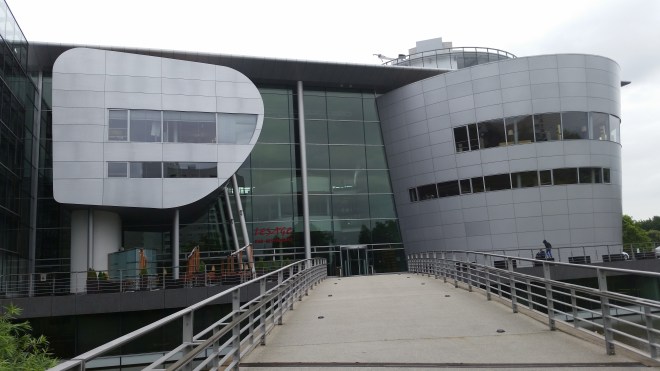
VW-TransparentFactory-20160715_134037.jpg

Initially, we were disappointed to learn that the Phaeton production line has been shut down and being transitioned to a new model.  That disappointment was short-lived however, when we realized the tour would now take us directly to the factory floor, instead of viewing it from a a catwalk above.  The assembly line was spotlessly clean, with wood floors (not what we expected!) because they are quieter and more comfortable for the workers to stand on. The Transparent Factory is an assembly line, where completed modules are installed on the auto chassis and body. The car body is carried along the assembly line in a giant claw on wheels, that can be positioned so the auto worker doesn’t have to assume any uncomfortable positions to install an assembly. The body and chassis are “married” on a hydraulic jig, then roll down the line for final assembly and testing. We would have loved to have made photos, but sadly that was not allowed.

We came to Dresden with an uncomplicated set of preconceptions, but we came away with a better idea of what a multifaceted city it is. It goes back to what we had in mind for this trip from the beginning: to spend enough time in each place to get a better idea of its  subtleties. We wish we could see more of the world in this much detail, but with our limited time, we are going to take in as much as we can.

 

Dresden – Past and Present Glory

Oh, Cologne

If you don’t like big cities, you won’t like Cologne. We do, so we did. There’s a lot more to see and do than we could absorb in the few days that we were there.

Maggie and I are big history buffs, so we delved into a couple of history museums. We learned that Cologne has been part of The Roman Empire, The Frankish Empire, The Holy Roman Empire, the French Empire, the Prussian Empire, Germany, West Germany and now Germany again. (I’m using the spelling of the city name that we get from the French; it’s Köln in German, or Koeln if your keyboard doesn’t have an umlat.) Today the city is a mixture of old and new, existing side by side.

Cologne-5

The Germans we met encourage visitors to speak their language; maybe that’s partly because Cologne has been a part of so many different countries. There are lots of other reasons, as well: there are 90 million native German speakers in Europe, more than any other language. Germany has earned its place as one of the economic leaders on the continent. They are justifiably proud of that accomplishment, so they expect that visitors will give their language and culture the respect it deserves. You will find plenty of people  who can speak a little English, but you can’t assume that everybody is ready to carry on a conversation. You’ll be OK if you learn the basics: a simple greeting, please and thank you, and a few numbers will make things go a lot easier.

One thing you have to give the Germans credit for, they don’t hide from their history. Several cities have museums that are partly or completely devoted to the history of Nazism. The National Socialism Documentation Center in Cologne is in the former Gestapo headquarters. It was an administrative building for thirty years after the war, until the trial of Kurt Lischka,  the head of the Cologne Gestapo raised public awareness of the history of the building. The resulting protests turned into a movement, and in 1979 the city and the national government voted to transform the building into a memorial, a museum, and a center where historians could study the history of the Nazis.

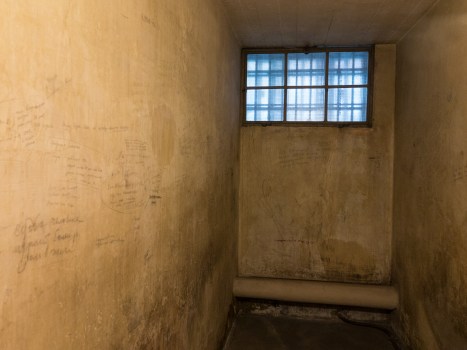
In the basement, here are cells where up to ten people at a time were held for interrogation and torture. This could go on for days, it might take weeks, or stretch into months. Up to ten people at a time were imprisoned in cells like this one:

Cologne-37.jpg

The walls are still covered in the original graffiti. The prisoners wrote with whatever they could find:  used coal, lipstick, even their own fingernails. They wrote their names, messages of encouragement to other prisoners, messages to their loved ones, drawings, diaries, calendars marking off the days, rants against their jailers – pretty much anything.  They wrote with no expectation that anybody but other prisoners would ever see their messages. The futility is heart-breaking, but at the same time, we were stirred by the tenacity of these people, to hang on to their humanity in the bleakest conditions.

There’s a yard out back, where executions were committed. The top floors house an in-depth study of the rise of National Socialism. The treatment of the Jews, Gypsies, gays, and other so-called “undesirables” gets a thorough description, both in large scale statistics and detailed histories of individuals.

The war itself doesn’t get a lot of space, because that’s not the focus of this museum. One large room shows the devastation that Germany caused and suffered during the war;  another smaller room describes the war’s after effects. As you walk down the last hall to the exit, the sound system automatically kicks in to Glenn Miller’s “In the Mood”. I needed that.

Cologne today is a new city, since 95% of it was destroyed in WWII by the British and American bombing raids, then rebuilt after the war, partly funded with billions of dollars in US aid. There are few old buildings that survived or were restored: churches, parts of the medieval wall and some artifacts left from the Romans. The central part of downtown is dominated by a shopping district that’s packed with tourists. I don’t know why. It’s the same high-end stores selling the same luxuries that you can find in every major American or European city – if all they’re going to do is buy unnecessary stuff, why do they go to Cologne, Prague, or Rome when flights to Las Vegas are so cheap? You might wonder if this is what the framers of the Marshall Plan had in mind when they were laying out the plans for the rebuilt city – but on the other hand, how can we deny the people of Cologne the right to remake their city according to their own needs?

We didn’t spend a lot of time shopping for clothes, but you gotta eat. After paying too-high prices in England, Scotland and Ireland, we were relieved to find that everything was back down to levels we were used to – sometimes even less. French and Italian wines were a deal; at home we try to keep the price of a bottle of wine in the $10 to $20 range. In Cologne, the 5€ (about $5.50) wines were pretty good,  and for 8€ we could get a bottle that was as good as we ever drink. The selection was great, and we got to try out some wines that we had never heard of.

As we were leaving, a giant outdoor festival was starting up that had venues all over the city. We got to see a little of the preparations before we left, enough to make us think that Cologne would be a good destination for a longer visit. That’s what we love about big cities: there’s always something going on, even if you don’t always get to take advantage of it.


Oh, Cologne

Cork – I barely knew you!

After leaving Dingle, Ireland we headed to Cork to catch our flight to Germany for a few weeks.  We discovered that we had a couple of extra days, so we decided to spend 3 nights in a hotel in Cork which gave us only a couple of days to explore Cork. This was our first hotel stay of our trip.  The old beautiful hotel in Cork was excellent, but after our independent living for several months in apartments and home rentals, we had a little adjustment to make.  We survived quiet nicely I might add.

After being in Cork for a couple of days we realized we had made the first (but hopefully  the last) mistake of our trip.  Cork was awesome!  We should have stayed longer.  There were great restaurants, pubs, live music, and hiking around the area.  Unfortunately, we didn’t get to hike because of the short time there, but learned a lot about hiking in the nearby areas at the Cork Visitor Center.   We would encourage anyone going to Ireland not to forget about Cork!  It is a foodie place for sure – from local pubs to gourmet restaurants that fill the city with delicious smells.

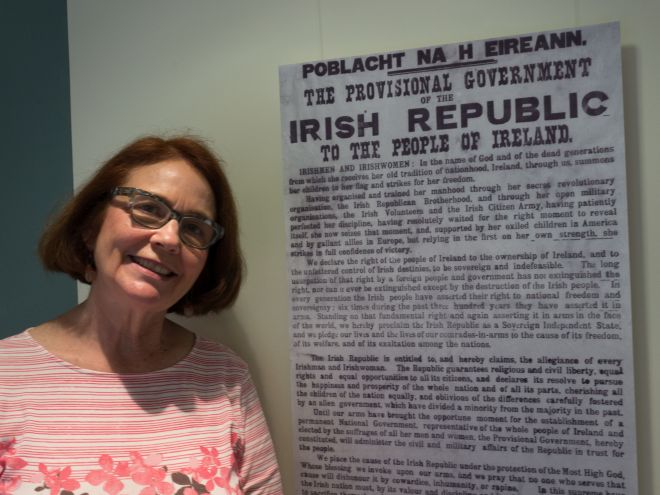
Being in Ireland for the 100th anniversary of the 1916 rebellion we decided that we needed to be more educated about the uprising so we headed to a museum in Cork totally dedicated to the 1916 rebellion.  St. Peters Church was chosen as the site for aligning with the National Program of  “remembering, reconciling, presenting, imagining and celebrating”.  Below is a copy of the 1916 declaration on the wall at St. Peters Church annex.

Maggie at Museum


We spent hours there and learned so much about the rebellion.  Toward the end we met a wonderful Irishman who upon finding out we were Americans, went out of his way to give us additional information.  He kept stressing that the organizers of the rebellion were a band of “poets, Irish language enthusiasts, former British soldiers, and a revolutionary Marxist”.  Interesting to Clay and me was the fact that all this happened while Great Britain was mired in WWI with tens of thousand Irishmen fighting for Britain.  I had a hard time wrapping my head around the irony of all of this.

As with any Irishmen who has found two good listeners – he also launched into the current events of the day – Brixit.  He shared his concerns that there is so much to work through, and he held no expectations that Northern Ireland and Ireland might reunite as a result of this.  He also fascinated us with his knowledge of American history.  When he mentioned that he even had learned the state capitals of all 50 states.  I said “may I challenge you?” giving him a way out so he went for it.  A lot of people assume or guess that Birmingham is the capital of Alabama, but he quickly without hesitation said -“Montgomery of course”.  I was impressed.

This casual meeting with the Irishman with a love of American history is the true purpose of traveling to me.  No check lists for us.  We leave lots of time for really talking to people.  I still believe that you cut your “to do” list in half for a trip and give yourself more time to really communicate with the locals.  We are learning so much about the people of Ireland!  It’s good!

Before we headed to the museum we had walked through their farmers market called The English Market.  As a foodie myself I gave it an A+.  They even have a cafe and restaurant upstairs that get their food directly from the downstairs market.  Clay and I agreed that the best meal that we have had in Ireland was at the Farmers Restaurant.  From the fish main course to the dessert we were in foodie paradise.  Cod was on the left in the photo, and potatoes on the right.  We shared the delicious greens and fresh peas as our side.  When the dessert arrived we scarfed it down before we remembered to take a photo.  Sorry.

Cod at famers market

The visit to Cork was too short folks!  The blame is mine (Maggie), but don’t you make the same mistake and consider Cork on your Ireland itinerary .  Saturday morning came to quickly, but our flight to Cologne was departing, and off we went to begin the next phase of our adventure in Germany.


Cork – I barely knew you!

Down in Dingle

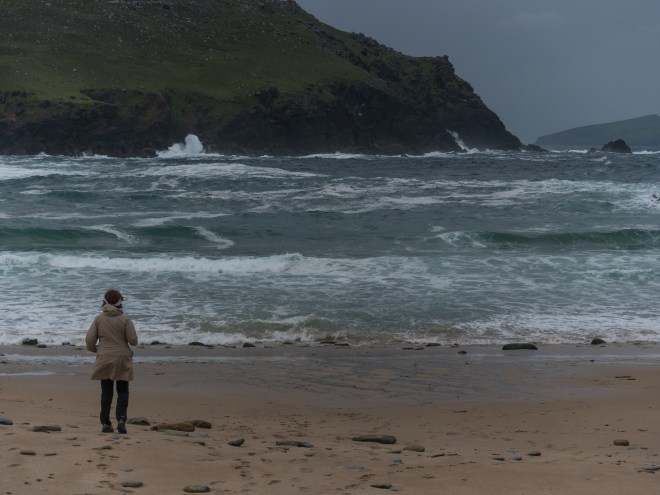
Why Dingle? Because the most Irish person we know said it was the one place to go in Ireland, if you couldn’t go anywhere else. Having been there, I can see why. First of all, it’s beautiful everything is Irish green but the sheep because it pours rain every day even in July and oh sorry I got off the track a little. Second of all, it’s the most easily accessible place to go where Irish is spoken. There are Irish communities where people live year round, Irish schools where students come to learn the Irish language and culture, and people who come here to restore their connections to their roots. Third of all, Dingle has a little of everything you’re looking for in Ireland: several good pubs, lots of good music, some nice restaurants, an old church, and a  short drive away there’s a scenic loop with wild landscape and artifacts that date from recent history to the Stone Age.

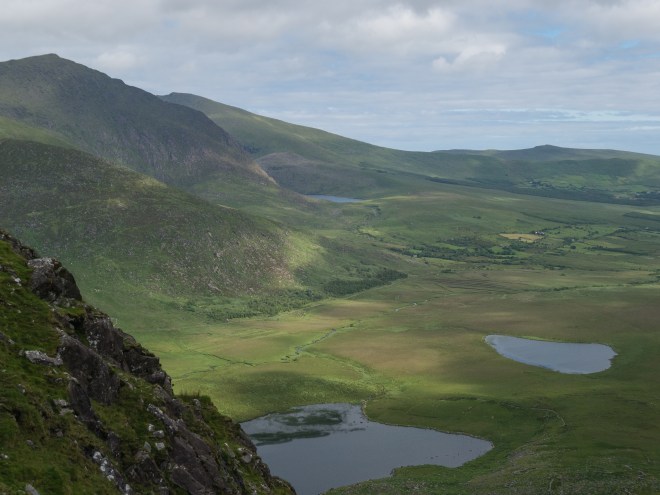
If you plan it right, your introduction to Dingle is a trip over the magnificent Conor Pass. You wind your way up the mountain side on a twisty little road that’s single track for a long stretch, overhung by rocks flowing with water from unseen streams. At the top there’s a pullout where you can look at the two valleys on either side: on one side is the land you just came from, spreading out across low rolling hills to the sea, and Dingle waiting below you on the other.

The village of Dingle has two main strips: one runs up the hill and one along the harbor. On the hill, nearly every business is a restaurant, a pub, a pub/restaurant, pub/hardware store, pub/antique store, or pub/dry goods store. Nobody goes hungry or thirsty around here, even while buying a hammer. I hope that store doesn’t sell power tools.

The strip along the harbor is unfortunately, for the tourists. There are T-shirt shops, fish and chip carts, souvenir stands and tour companies of all sorts. The bright spots are The Chart House restaurant (really good food is a classy but comfortable atmosphere, not part of the American chain with the same name) and Murphy’s Ice Cream, with the boys and girls passing out samples on the street, their faces as fresh as cream.

When you’ve had enough of this, you don’t have to go far to get away. Keep on driving, in a few minutes you’re on the scenic route around the Dingle Peninsula, known as Slea Head Drive (Ceann Sleibhe in Irish). All of the signs are in English using bold block letters with the Irish in a smaller font and italics above that. It made me wonder how long it will be before that’s the other way around. The English have dominated southwest Ireland for 800 years, so it will probably be a while longer.

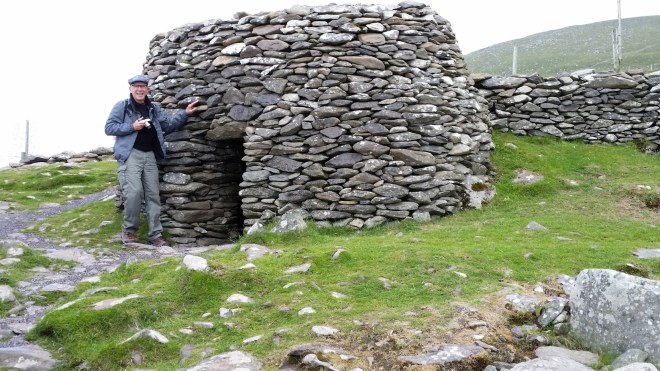
You don’t need me to describe the loop in detail; Rick Steves did a good job of that.  So I’ll just show you some of the pictures we took.

DinglePeninsula-Clogher-7DinglePeninsula-Clogher-21

DinglePeninsula-20160701_100311

In the other direction from Dingle is Brandon Point, which is not as dramatic as the Slea Head Loop, but well worth the trip, for hikers at least.

BrandonPoint-3BrandonPoint-5BrandonPoint-27

We had a B&B that was walking distance from town – just far enough to be dark and quiet at night, and with great views. Kevin, our host, was a wealth of information. Listening to him, we truly understood how a person could love living here. We loved our time here, too, but for us it was time to move on.

Dingle-9

Down in Dingle

It’s Galway [gawl-wey] ya’ll

We arrived in Galway from Dublin by train with high expectations for this city.  Galway, a harbor city on Ireland’s west coast, didn’t disappoint.  We got a taxi to our new AirBnb hoping that it was a good choice for our 7 day stay.  It was.  Once again we arrived to meet our host and found a very clean, modern apartment – not in Galway (the city), but in a little seacoast city of Salthill.  Salthill is a 20 minute walk or 5 minute bus ride into the city center of Galway.  Perfect location and apartment as we had anticipated.  With a 2 minute walk to the bus and a 5 minute walk to the Atlanta Ocean – we concluded that “we did good”.

One thing that surprised us; however, was the size of Galway.  We would have guessed 100’s of thousands of residents, but come to find out it only has 75K people.  So much packed into this lovely city. Being a college town, it has a youthful exuberance that makes it feel so lively.  Lots of traditional pubs that offer live Irish folk music not to mention art museums, galleries, and restaurants.

First Day Trip from Galway – Connemara

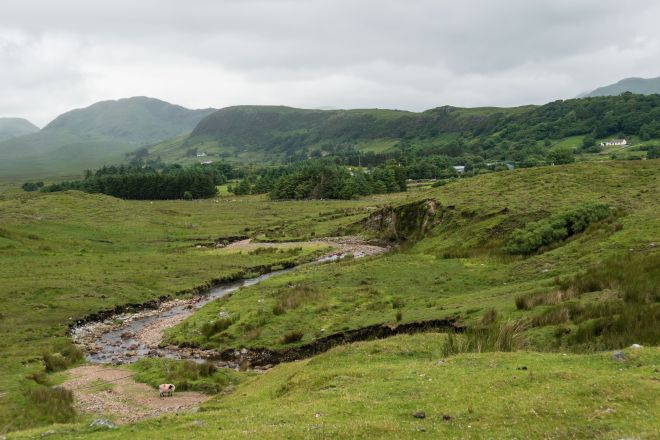
We decided not to get a rental car here, but instead picked 2 separate day trips with a local tour company.  Yesterday we went to the Connemara region with numerous stops in local villages, and stops for camera enthusiasts to capture the raw landscapes and wild Atlantic coastline.

Rugged country

Waterfall with 2 girls

Small House

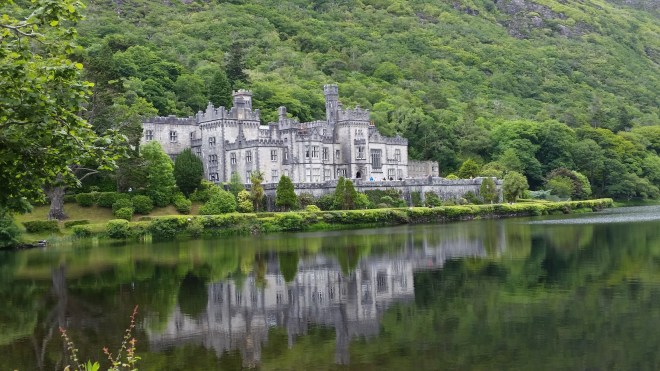
The highlight of the trip for us was the 2 hour stop at Kylemore Abbey (below) which was extravagantly located on a lake in the midst of the mountains.  This Abbey is also home to the Benedictine nuns.   Here are a few photos from the Abbey, and after the photos a little more history of this masterpiece of construction for the time.

Abbey

The Abbey


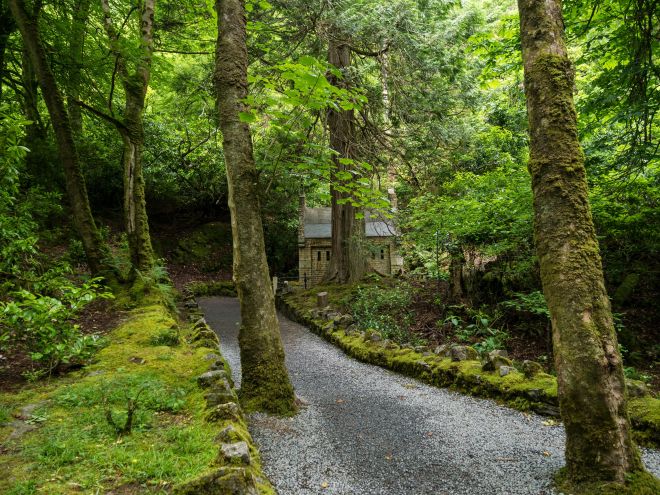
Next to the Abbey was the Gothic Church, a miniature Cathedral that was build by Mitchell Henry in memory of his wife Margaret.

The Gothic Church


And, further to the right of the church was the Mausoleum (see below)  where Margaret’s ashes were interred after her death from dysentery, and then later Mitchell’s ashes after his death at 84.

Mausoleum with green

The Mausoleum


Kylemore Castle was built as a private home for the family of Mitchell Henry, a wealthy doctor from London,England. He moved to Ireland when he and his wife Margaret purchased the land around the Abbey.  They had visited there while on honeymoon in 1850 and she was so charmed by Connemara that Mitchell purchased the estate (15K acres!) as a gift for her; thus building one of Ireland’s most iconic castles in 1862.

Mitchell Henry was a kind man and eventually represented Galway in the House of Commons, and was a strong advocate for home rule.  He set up a school on the grounds of the Castle because he wanted his tenants’ children to get an education.  Also, in hard times he reduced the tenants’ rents.

Since 1920 the Abbey has been home of the Benedictine nuns.  They arrived there during WWI as refugees having fled their monastery in Flanders.  The nuns have a long standing tradition of education.  Irish nobility sent their daughters to be educated with the Nuns.  It evolved into an international board school which operated until 2010 when the school closed.  It closed because of declining number of students and aging nuns.


Second Day Trip from Galway – The Cliffs of Moher

Having enjoyed our 1st trip with Lally Tours, we opted to do a second tour rather than rent a car and go ourselves.  Good decision I think.  The big attraction for this tour was The Cliffs of Moher, but there were additional stops at Dunguaire Castle, Aillwee Cave, and lunch in a local pub in Doolin.

Since the Cliffs were the main attraction we were excited to go, but our expectations were greatly exceeded.   The Cliffs were awe inspiring stretching 5 miles and standing 700 feet tall at the highest cliff.  Wind was a wee bit of a problem for us at 35 mph, and gusting much faster of course.  We were happy; however, that it didn’t rain on us, but slightly overcast all day.  Below are some photos taken on the tour, and a few photos of some people that were a little too close to the edge of the cliffs in my opinion.

view of cliffs maggieSeveral CliffsCliffs with bird

Of course there were you usual tourists who got to close to the edges.  The “bad hair photo” of me is why I think it was not a good idea to get too close.


We chose not to do the cave portion of the tour because I am a little claustrophobic, and besides the grounds were beautiful so we opted to take photos instead.  The cave tour was so short (30 minutes) so I don’t think we made the wrong decision. Do you?

scene from caveClay on Fencemaggie on rocks

As you can see the weather is interesting around here.  The photographs of Clay and me were taken just a few minutes apart.  I guess the sun was shining on the better of the two of us.  (wink!)

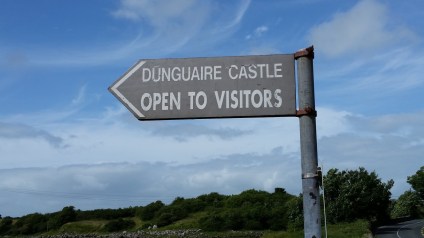
Also, we had a short stop at the most photographed Castle in Ireland according to our tour guide.  You know; however, that you can always trust what a tour guide tells you…..except me.

castleCastle sign

Here it is our last day in Galway after a week packed with interesting things to do and places to go. Enjoying catching up on our Facebook posts and our travel blog.  Tomorrow on to Dingle, Ireland.


It’s Galway [gawl-wey] ya’ll

Beer, Books and Bogs in Dublin

Next on the itinerary was a four-day stop in Dublin. Four days was not nearly enough time, but we did get a chance to get beyond the cluster of pubs in the Temple Bar district.

Our first stop was to the Guinness Storehouse: a complex of warehouses for the Guinness brewery, with one large building set aside as a museum of the history, craft and culture of Guinness. They even offer a lesson in the technique of pouring a pint of Guinness stout – you learn a new skill, get a certificate and you get to drink the pint after class; a useful education if you ask me. A cynic might dismiss the whole thing as a way to get people to pay for a two-hour Guinness commercial, but hey, nobody’s forcing anybody to go. Maggie and I had fun, we learned some things about the brewing process, and as part of the admission price, we each got a pint of Guinness, poured for us in the rooftop bar. We shared our table with a couple of beautiful 20-something American nurses, on a day’s layover in Dublin on their way to Croatia. All in all, I’d have to say it checked off all my boxes for a great way to spend an afternoon.

The Chester Beatty Library is a shrine to books. It’s divided into two parts: there’s a research library, where experts can come to examine the old and rare volumes that make up the collection; then there’s a museum of books that’s open to the public. The age and breadth of the collection is astounding.

On the first floor, there are love poems from 1160 BCE; Egyptian Books of the Dead on papyrus;  European, Japanese and Chinese prints; a display of book bindings with leather carved into intricate patterns.I got caught up in some woodcuts by Albrecht Dürer, which I had seen in books but never realized how tiny they are. Maggie was captivated by a Japanese love story, presented as a graphic novel in page after page of beautiful illustrations and calligraphy, with English translations presented alongside.

The second floor of the public display is devoted to religious books: mostly Christian, Jewish, Muslim, Buddhist, and Hindu works, with a small display on Manichean writings. Chester Beatty had one of the world’s most complete collections of ancient Korans. Maggie and I had already been introduced to the beauty of Arabic script, which covers the walls of the Alhambra in Grenada, Spain. What was amazing about these was the level of detail: pages and pages of script written in gold ink, each character outlined in a delicate line of black, so thin it was almost invisible. Some were miniatures from the early Mughal Empire, predating restrictions on images of people and animals. They were a tiny window on a different version of Islam, before the rise of fundamentalism.

We spent some time in the Archaeology wing of the National Museum of Ireland, which covers the history of prehistoric Ireland. It turns out that the peat bogs that cover so much of Ireland are a perfect environment for preserving artifacts: when something falls in the bog, the peat slowly grows over it; once it’s covered, the mixture of mud and water keeps out the air, so artifacts, animals, and people who wound up in the bog are found intact centuries later. We saw iron spear points, perfect except for a thin layer of rust; gold crescent-shape necklaces with their fine details easily visible; a wooden wheel from 400 BCE. The big attraction is the “bog bodies:” remains of four ancient kings, executed and buried in the bog. Archaeologists can tell they were kings because their remains show that their diet and health were far above average for their time. Their hands and bones don’t show the signs of the hard manual labor most people endured back then. The most telling evidence is that their nipples had been cut off: back then subjects showed their fealty to the king by sucking on his nipples – a demonstration that the king was the source of everything. With no nipples, he couldn’t claim kingship in this world or the next.

On this whole trip, our only regret has been not spending enough time in each place – we have yet to get bored, or stay in one place longer than we wanted. Our visit to Dublin was definitely in this category. We’d like to say that we saved something for next trip, but it’s a big world and our time on it isn’t endless, so I don’t know if that will happen. Our hope is that people will read this blog and share their stories, so we’ll all get to see a little more of the world.

Beer, Books and Bogs in Dublin

Stonhenge

Stonehenge-12.jpg

Maggie and I finally got to see Stonehenge in real life. The pictures and stories we’d  seen didn’t prepare us to understand impact the site had on prehistoric Europe. There’s a lot more to the story than just the stones. First of all, there is the site itself: the surrounding area is dotted with mysterious constructions of various sorts. Clearly this was a significant place in the religions of the time. Then there was the difficulty in assembling and carving the stones themselves. Based on the technology of the time, getting the stones to the site was a tremendous task; it consumed immense resources of time, manpower and materials. The evidence of the distances people traveled to be here was a revelation to us. Being here answered a lot of our questions about what happened here, but didn’t answer the questions of why: Why these stones? Why this arrangement? Why here?

It’s no accident that Stonehenge is in this precise location. In the surrounding area, there are dozens of human-made constructions, some in large, definite patterns, and some that date back 10,000 years.  There are circular ditches, groups of post holes, causeways and burial mounds large and small. Half a mile north, there’s the Cursus, built about 3500 BCE, a rectangular ridge two miles long and about 400 feet wide that marks the positions of sunrise and sunset on the summer solstice. There are the remains of Woodhenge, a forest of stakes a couple of miles away, built about 2500 BCE. Stonehenge is actually a set of features: it’s bordered by a circular ditch and ridge 300 feet in diameter  that dates back to about 3000 BCE. The circle of standing stones dates back about to about 2500 BCE (about the same age as the pyramids of Egypt); it was modified from time to time over the next 900 years or so, which makes it one of the newer features in the area.

Building Stonehenge took tremendous effort. The first stones (“blue” stones), placed in the inner ring, came from the Preseli Hills in western Wales, a distance of about 150 miles. They might have been hauled on rafts down the Bristol Channel, then dragged on sledges to get them to Salisbury plain.

Basic CMYK
Source: english-heritage.org.uk

The larger stones, weighing up to five tons,  were brought in from the Marlborough Downs, about 20 miles north. The stones would have been carried on a wooden platform that rested on logs, that weren’t attached to the cart, but rolled underneath. (The wheel had been invented, but wouldn’t make it to Britain for another thousand years.)  As the cart moved along, the rollers would have been left behind one by one, so another group of people would have been needed to carry the last roller around and put it back at the front. Pulling the cart any distance would have take 100 strong men – a twenty mile trip would have needed several teams of men relieving each other at intervals. It’s not clear if animals were also used in the hauling, but there were domesticated cattle in the area at the time, so it’s possible.

SledgeOnRollers

Each stone was carved into a specific shape and fitted to its location. The vertical stones are each standing in a post hole, with a bump carved on on its end that fits into a groove carved into the horizontal stone on top, which was hauled into place with ropes and ramps. There must have been some tremendous scaffolding around the vertical stones to support their weight, plus the weight of the top stone, the men, carts, possibly oxen and everything else needed to delicately place a stone weighing several thousand pounds in exactly the right position 18 feet above ground level.

As famous as Stonehenge is today, it must have been equally well known in its time. Based on the artifacts and human remains left here, people traveled long distances to be here: as far away as present-day Turkey, a distance of 2000 miles.They would have come on pilgrimages: there is evidence of ancient dwellings, not permanent residences but only used during ceremonies. These temporary villages were in use for hundreds of years. There was a wide road that led from the river Avon into Stonehenge; Magie and I imagined processions of ancient kings, arriving with great ceremonies of music, dancing, feasting to celebrate the union of the people with their gods.

What we don’t know is why. We don’t know why these particular constructions were built in these exact ways in this spot. It’s obvious that some of the features of Stonehenge line up with the summer and winter solstice, but there’s only a few stones that have any part in those observations – what are the rest of them here for? Why were the stones brought such tremendous distances? One theory is the blue stones were venerated because of their color, or the ringing sound they make when they are struck; it may be that the source of the blue stones was itself a holy place: either because of the presence of healing waters, an origin myth that is lost in time, or the presence of Psilocybe mushrooms. That works for Wales, but doesn’t say why these plains were considered holy. Clearly it was highly significant, otherwise they wouldn’t have taken all of these people away from everything else they would have been needed for: growing crops, tending livestock, defending their land from invaders, raising children and so on.We don’t even know why the site fell out of use, about 1600 BCE; Druids, Romans, and Christians wouldn’t arrive for another 1000-2000 years, so that sun-worshiping religion was replaced by something we have little knowledge of.

We will never have all of these answers – writing had been invented, but hadn’t made it to Britain yet, so the only evidence we have is the stones themselves, and what few artifacts were left. The people left no other trace, not even an oral history, so it’s left to us to invent our own stories and rituals around the stones.


Stonhenge

Long live Cornwall

Oh, how we loved you!  This was the first place we stayed that we only stayed for one week, and as it turns out one week was definitely not long enough.  The 3 main activities we did while in Cornwall were:  hiking (best ever!), music (surprise), and eating!  We passed on castles, cathedrals, because we had something else in mind.

We based our visit out of Boscastle.  Boscastle is a village and fishing port on the north coast of Cornwall, England.  Our little apartment turned out to be much larger than the AirBnb photos had shown.  We had 3 bedrooms, living room, big kitchen, separate dining room, but oddly only one bath.  It was extremely clean, and very old and perfect for the 2 of us.

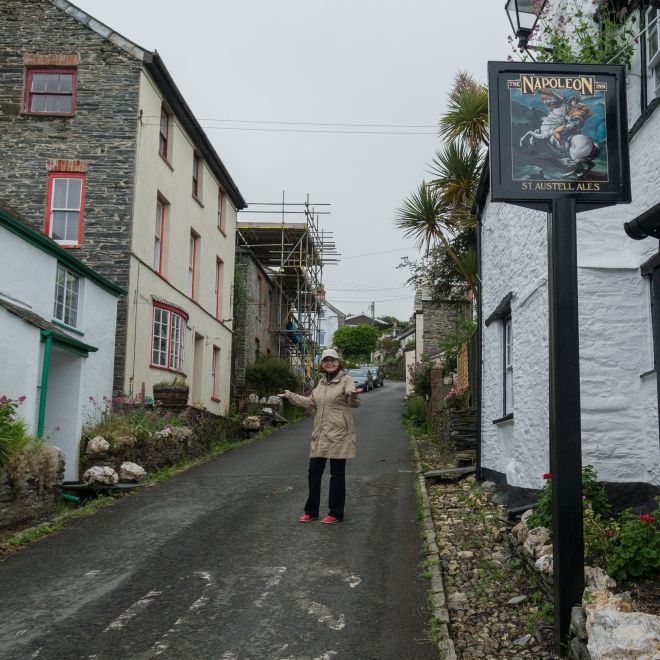
Our apartment was right across the street from the Napoleon Pub.  In fact, we called it our 12 step program because we were literally right across from the Pub.  We actually measured the distance and turns out it was 20 steps, but a 12 step program sounded better.  Usually one doesn’t associate pubs with good food (just beer!), but this place was an exception.  We actually ate there 2-3 times.

Maggie Pub

Boscastle Harbor provided the perfect walk to hike up to the coastal walkway!


Five years ago, I made a trip to Cornwall with a Road Scholars Tour group.  Clay didn’t get to go because he was still working at the time.  I wanted to show him some of my favorite hikes from that trip.  My favorite then, and now too, was the hike from Boscastle to Tintagel.  It did not disappoint as the photos below show.  It is a 5.5 mile hike, and mostly up and down so a little strenuous at times.  We make it in about 3 ½ hours so we thought we did well.  We had lunch in Tintagel, and then caught a bus back to Boscastle.


Another great hike was near Padstow.  Padstow is this cool little fishing village, and after our hike we had our first Cornish pasties.  They were good, but honestly, we neither one thought it good enough to order again.  Here are a few photos from Padstow and the hike that we took from there.

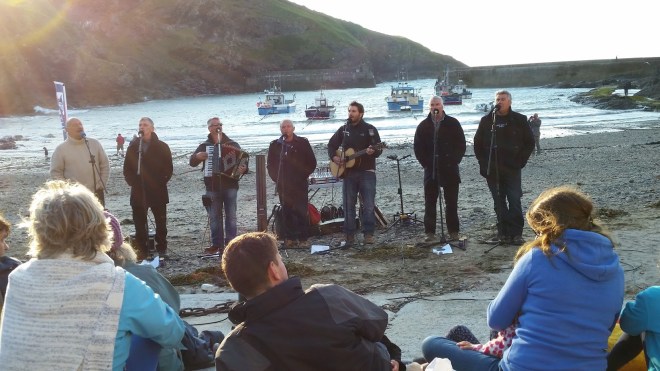
Music was a real surprise while we were in Cornwall.  We were over at the local pub one evening and while standing at the bar drinking a pint, we started a conversation with a local guy.  Turns out he was a member of the singing group the Boscastle Buoys.  It is a band of Sea Shanty singers who entertained us well after our usual bed time.  They were an amazing group, and honestly I thought at the time that they were just a good as the more famous Fisherman’s Friends.

Boscastle.jpg


Enjoying the Boscastle Buoys so much we decided at trip to Doc Martin’s little town of Port Wenn as it is called in the series. Actually it is Port Isaacc where it was filmed.  Fisherman’s Friends show up every Friday night to put on a show for the locals as well as the tourists from all over Cornwall.  We enjoyed the show sitting on our butts just a few feet in front of the harbor and the singers. Port Isaacc is an amazing little village!  And, yes for you Doc Martin fans, that is his surgery 2nd house from the left.

Port Isaacc Habor

The Sea Shanty group, Fisherman’s Friends ended up putting on quite the show for us.

Fishersman friends

Food in Cornwall?    Pub grub was much better than I had expected.  My only complaint about the food was that all the menu’s seem to have the same things on them – fish and chips, pasty’s, soup, specials heavy on the meat, potatoes, and usually one curry.  Not as much variety of food that I was used to.

One of our favorite places to eat was just about 1 mile from our Boscastle home.  it was fun to walk down to the Boscastle Harbor, and then walk up to the Farm Shop situated along the coastal path.  The Farm Shop was on a local farm about 50 yards to the coastal path with spectacular views from the outdoor picnic tables.   They seem to have a great passion for great quality local produce!  We loved our visits there, the walk, the food, and one day – even a trip just for dessert!

Food Store

In conclusion our only regret about beings in Cornwall was that we didn’t spend enough time here.  Perhaps we will come back one day and spend another week or two.  One never knows when Cornwall will call us again.

Long live Cornwall

The Cotswold Olimpicks

Maggie and I got to witness this year’s presentation of a 400-year old tradition: the Robert Dover Games, aka the Cotswold Olimpicks. That’s not a misspelling; the town of Chipping Campden is proud of its heritage, and they like to bring it back alive in any way they can.  The Olimpicks is a celebration of sports that have been played in the English countryside for a long time. Some are familiar: tug-of-war, sack racing, log throwing, and “champion of the hill”- a foot race up a steep incline. Others are not as well known, like welly wanging – a contest to see who can throw a rubber farmer’s boot (called a welly, short for Wellington) with the most distance and accuracy; there’s also dwile flonking, which is essentially dodge ball played with a wet bar rag, and the dodgers have to keep dancing while they dodge. The Olimpicks doesn’t have all those sports every year, so it’s like a box of chocolates (Except for one event, the shin kicking, that happens every year; more on that later.)
This year, the games began with a few warm up acts: we saw a couple of dance troupes and a demonstration of a sword fight between two medieval knights. Then an actor playing the games’ founder, Robert Dover rides in on a horse with his entourage walking behind. Everybody is decked out in medieval garb, which would have been way out of fashion by the 1600’s, but that’s nit picking.

After the procession, the competitions started. This year there were a lot of relay races: a sack race, a wheel barrow relay over an obstacle course, a race while bouncing on big rubber balls, and  a competition between teams trying to fill trash cans with water, using small leaky buckets. The last two were run on plastic sheeting drenched in dishwashing soap, with people throwing buckets of water at the contestants (not traditional, but fun to watch. That ended with a water fight with the filled trash cans, followed by winners and losers alike joining in sliding across the plastic sheeting – on their bellies, backs, or knees.

The most popular sport (with the fans, anyway) is probably the least played: the shin kicking. That’s pretty much what it sounds like: two guys (always guys, no comment needed) grab each other by the shoulders and kick each other in the shins. As the web site says,”the hillsides ring with the sound of boot on bone.” That goes on until one of the kickers falls down. Two falls out of three wins the match.  Even in such a savage game, there are rules: no kicking above the knee; no pulling your opponent to the ground; the only protective gear allowed is straw shoved up the pants, and only leather shoes are allowed –  no steel toed boots. The rules are enforced by a “stickler” (yes, that is where that word comes from).

This year, there were several preliminary matches, then the final match to determine The Shin Kicking World Champion. Adam Miller defended his title against Zac Warren, a previous world champion. The preliminary matches had been relatively quick; this one went on and on. In the end, Adam Miller was declared the winner on a TKO when Zac Warren couldn’t stand up to go back in the ring. I think we were all a little relieved. There’s a video of the event on YouTube if you’re interested in seeing more. RobertDoverOlimpicks-61c

After dark, there was a fire eaters’ act on top of the hill: a trio of trashy looking women scantily dressed in semi-ripped clothes. I suppose the tricks they were doing were pretty standard for fire eating, but they had my attention. RobertDoverOlimpicks-79.jpg

The fire eaters were followed by one of the better fireworks shows we’ve seen in a while. Where in the U.S., the grande finale is usually the part where they let off a bunch of explosions all at once, here they did that, and kept going. They went back to single fireworks that just kept getting bigger and bigger. It was more amazing because it was so close; they were letting the fireworks off in the valley, and we were on top of the hill, so they were exploding right in front of us. I’m sure it was totally safe, but it felt like they wouldn’t get away with that at home.

Finally, the last event on the hill: the bonfire: a mountain of various wood scraps dumped into a giant receptacle that looked like a trash can. All of that disappeared when the lit the fire, though. Nothing but flames and sparks lighting up the night.

We had bought torches earlier, now we all lit our torches from the bonfire or somebody else’s torch, and we started a procession back to town. Maggie had described a silent procession form previous years,  but this time it was pretty raucous. For a little while, we got caught in front of some teenage boys that just wanted to hear the sound of their voices.  I think I would have preferred the silence. RobertDoverOlimpicks-87.jpg

Back in town, we extinguished our torches in in the bins provided, and they started up a street party of the young folks. It was bed for Maggie and me – we’d had a long and memorable day already.


The Cotswold Olimpicks

Surprises in Cirencester!

One of our day trips in the Cotswold region turned out to hold some pleasant surprises.   At the Corinium Museum in Cirencester, Clay and I were surprised by how much we learned about Roman-British history, but also about a newly discovered potential secret Christian code. Later we were also surprised when taking a walk into the countryside, a local farmer’s wife told us about a  small church down the rural trail that held a secret”.  We were hooked.  We had to go.   More on that later, but first I will tell you a little about the town itself.

A lot of people refer to Cirencester as the Capital of the Cotswolds.  During the Roman occupation,  it had a population of about 20,000 people, and was the 2nd largest city in England behind London.  The town’s Roman name was Corinium, and the earliest known reference to it was in AD150.  Ironically, today it is about the same population as in Roman times.  I thought that was so interesting and it tweaked my interest in finding out more about this town.

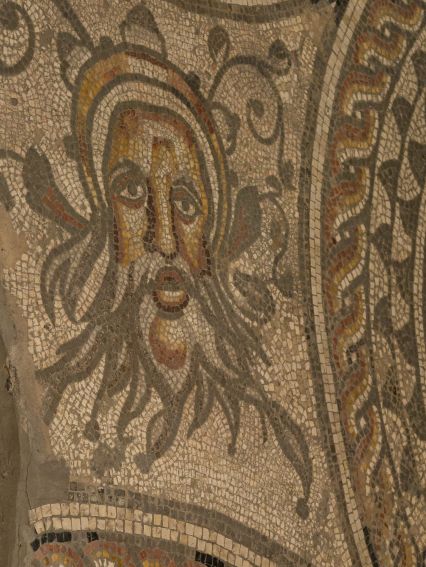
We arrived mid-morning and headed straight to the Corinium Museum, which documents the Roman history of Cirencester, or Cornium as it was known in Roman days. We learned that the Romans had arrived in Britain in 43AD, and that by 75AD the town of Corinium Dubunnorum was born. We also learned that there was an extensive public building campaign during this period of time including the 2nd largest known Roman bath, a forum complex as well as an amphitheater. The town itself was laid out in the traditional Roman style.  Recently discovered Mosaic floors are on display as well.

Tiles

The museum has a collection of many Roman objects which gave us an idea of what life must have been like in a Roman-British town. The gravestones provided a lot of details giving details such as age, names and places of origin, which show how cosmopolitan the town must have been.  The stone altars and religious sculpture are evidence of the variety of religious beliefs practiced in the Cotswolds.

There is also the Acrostic – a Roman word square that reads the same forwards as backwards.  This is one of only 11 found to date in the world and one explanation is that it holds a secret Christian code.

Christin puzzle

Explanation of Puzzle

After a hearty lunch at a French (yes, French!) restaurant, we got a map from the Visitor Center, and headed out for an afternoon walk through the country side.  While walking we met a local woman – the wife of a farmer who stopped to chat with us for a few minutes.  We told her we were headed to the hamlet of Baunton.  She looked a little surprised that we were going to such a small place instead of the usual tourist towns.  She obviously delighted in telling us not to miss the small local church in the parish.  There was a secret there we should fine.  Of course, we encountered a few sheep along the country path.

sheep

Finding the church was easy since it was such a small church.  I must admit that I felt a little spooky walking through grass that looked like it had not been mowed in some time – not to mention through the cemetery.  When I got to the door I thought it was closed (locked), but Clay figured out that I wasn’t putting enough “push” on the door and that it was open.  Subconsciously, I think I was hesitating to go in because of what the farmer’s wife has said about a secret find.

church yard

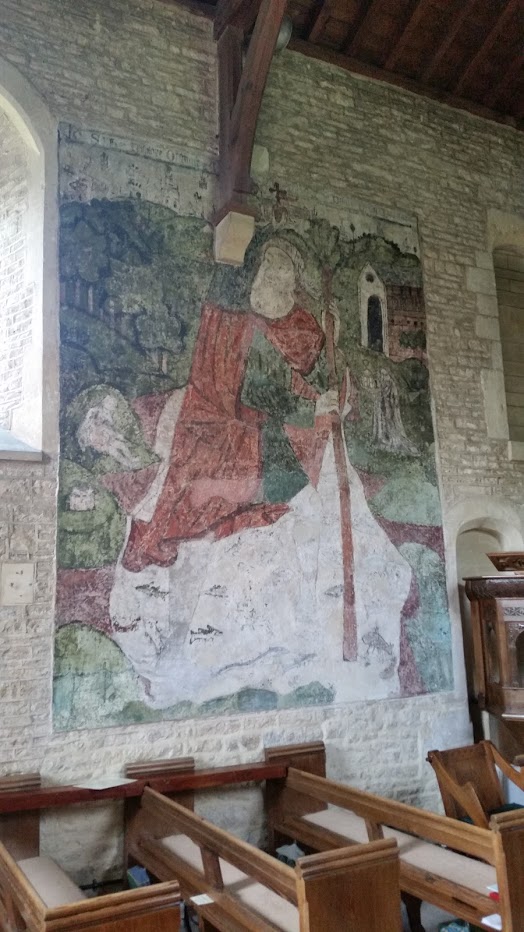
Well it didn’t take to long to discover the surprise she was referring to.  The church was so small, but on the wall was as it turned out a 13th century fresco with an interesting history.

St. Chrisopher

The painting was on the north wall of the small church and dates back to the 14th century.  It was covered with plaster during the reformation, and was forgotten about.  During the late 1800’s (1870?) it was discovered during a  renovation of the church.  Wow!

We left the Ciencester area very happy that we had made the drive over, and discovered some exciting surprises.


Surprises in Cirencester!